


Charging an AGM battery is not quite the same as the old-fashioned "full push" of a lead-acid battery. It requires a significantly more precise approach regarding voltage and current to avoid overcharging and damaging the internal structure of the battery. That’s why a special microprocessor-controlled charger is not just a recommendation here, but rather a necessity.
Why AGM battery charging requires special handling
AGM (Absorbent Glass Mat) technology has brought significant advancements in the world of vehicle batteries compared to traditional liquid acid lead batteries. While in a regular battery the electrolyte sloshes around freely, in an AGM battery it is absorbed into fine glass matting. This clever solution makes the battery completely leak-proof and maintenance-free – no more worrying about acid spills or checking the water level.
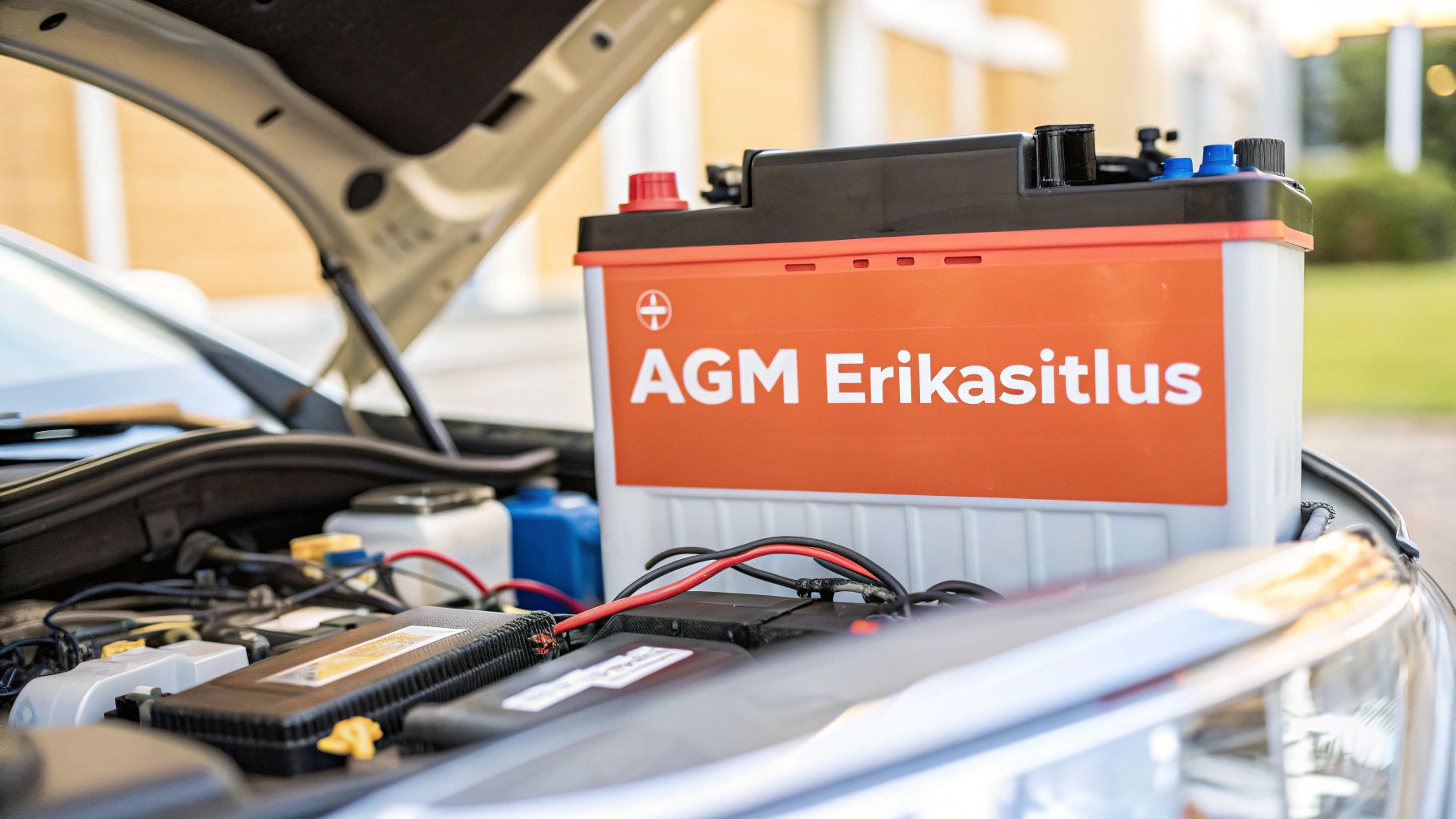
Due to their construction, AGM batteries also withstand vibrations and shocks much better. This makes them an ideal choice for modern Start-Stop system vehicles as well as machines operating in harsher conditions.
However, it is precisely these advantages that are the reason why AGM battery charging requires special attention:
- They are picky about voltage. AGM batteries are very sensitive to overcharging. Even slightly too high voltage can create gases in the glass mat that irreversibly damage it and drastically shorten the battery's lifespan.
- The need for a "thinking" charger. An old transformer charger sitting in the garage cannot provide the precise, multi-stage charging cycle required for an AGM battery. Using such a device is a sure way to quickly ruin an expensive and high-quality battery.
Proper charging is not an expense, but an investment in your car's reliability. It ensures that the battery serves you for its maximum lifespan and does not let you down when you least expect it.
Widespread use of AGM batteries in Estonia
There are more and more modern technologies on our roads, and with that, the need for specific maintenance is also growing. AGM batteries are already standard equipment in many newer cars. For example, the number of trucks alone increased by 75% in the post-independence period, reaching 135,352 by the end of 2020. This vividly illustrates how much the logistics and transport sector has expanded, which in turn requires increasingly professional maintenance, including the correct charging of AGM batteries. More about this trend can be read in the Statistics Estonia overview.
So, whether you have a family car, a van, a camper, or a boat – if its heart is an AGM battery, knowing the right charging techniques is critically important. In this guide, we will go through everything you need step by step, from choosing the right charger to practical maintenance tips, so that your battery lasts as long as possible in Estonia's changing conditions.
How to choose the right charger for an AGM battery?
Choosing the right charger is critical for the health and lifespan of an AGM battery. Forget about the old transformer charger from your grandfather’s garage that just pumps current in – a modern AGM battery needs a smart partner by its side. The best choice is a microprocessor-controlled smart charger that can charge the battery in multiple stages.
Such chargers do not blindly push current into the battery. Instead, they continuously analyze the battery's condition, adjust voltage and current precisely as needed, and eventually switch to a safe maintenance mode. This process eliminates the risk of overcharging, which is one of the biggest enemies of AGM technology.
What to consider when choosing a charger?
When looking for a charger, it’s easy to get caught up in the allure of cheap offers. However, it’s important to remember that the cheapest and simplest charger may ultimately mean buying a new and expensive battery. Focus instead on solid technical specifications that ensure the charger and your AGM battery are perfectly matched.
Here are some of the most important points to watch for:
- Special AGM mode: Absolutely the most important thing. Make sure the charger has a separate program for charging AGM batteries. This is often marked with the symbol "AGM" or a snowflake (❄️), as this mode uses slightly higher voltage, which is also suitable for charging at low temperatures.
- Charging current (in amperes): A good rule of thumb is to choose a charger with a maximum charging current of about 10% of the battery's capacity (Ah). For example, a 100 Ah battery is ideally suited for a 10A charger. A charger that is too weak will struggle to fully charge the battery, while one that is too powerful may damage it.
- Temperature compensation: This is an extremely important feature in our climate. A charger with a temperature sensor adjusts the charging voltage according to the surrounding temperature – raising the voltage in colder weather and lowering it in warmer weather. This protects the battery and ensures optimal charging at all times.
Many car owners mistakenly believe that the faster the charging, the better. However, the truth for AGM batteries is the opposite: slow and controlled charging is always the best choice for extending the battery's lifespan.
Automatic charging phases and why they are important
Smart chargers do much more than just fully charge the battery. Their working process consists of several stages, each with its specific purpose in maintaining the battery's health and ensuring maximum lifespan.
The table below provides a good overview of how different modes work and when they are needed.
Comparison of AGM charging modes
| Charging Mode | Description and Use Case | Recommended Voltage (12V battery) | Notes |
|---|---|---|---|
| Desulfation | Used to restore slightly sulfated batteries by sending low voltage and current pulses into the battery. | 15.6–16.0V (pulse) | Not suitable for heavily damaged batteries; helps revive long-stored batteries. |
| Bulk Charging | The charger provides maximum current until the battery reaches about 80% charge. | 14.4–14.8V | This phase involves the fastest charging. |
| Absorption | Voltage is kept constant, but current gradually decreases so the battery can gently "absorb" the last 20%. | 14.4–14.8V | This phase is critical for fully charging the battery without overheating. |
| Maintenance Charging | When the battery is full, the charger switches to maintenance mode, keeping the voltage low or periodically sending pulses to compensate for self-discharge. | 13.2–13.8V | Ideal for maintaining batteries in seasonal vehicles (boats, motorcycles). |
As you can see, this is a thoughtful process that treats the battery gently yet effectively, ensuring the best possible outcome.
How charging relates to higher maintenance costs?
Choosing a quality charger is not just a technical nuance – it is part of a bigger picture regarding the overall maintenance and reliability of the car. In Estonia, where the vehicle fleet is large and dependence on imported fuels and spare parts is high, preventive maintenance is simply economically sensible.
For example, in 2023, refined petroleum products worth 961 million euros were imported into Estonia, most of which goes to keeping the transport sector running. Proper AGM battery charging is directly related to fuel consumption and engine efficiency, ensuring that your car starts without issues even in the coldest frost. Larger fleets and workshops that order products in bulk from OILER partners like Castrol and Mobil know well that a functioning battery is the cornerstone of quality maintenance. If interested, you can read more about Estonia's foreign trade on the Statistics Estonia page.
Ultimately, investing in a good AGM charger is an investment in peace of mind. It ensures that your expensive battery lasts for years, not months, and that your vehicle is always ready to hit the road.
How to charge an AGM battery in practice?
Once you have found a suitable smart charger, it’s time to get down to the actual charging. Charging an AGM battery is not rocket science, but it does require attention to detail. This way, you ensure both your safety and the long lifespan of the battery. Let’s go through all the important steps together, starting from preparation and ending with the completion of charging.
Before you even pick up the charger, make sure the environment is safe. Although AGM batteries are sealed and leak-proof, a small amount of hydrogen is always released during charging. And hydrogen, as we know, is highly flammable. Therefore, always charge the battery in a well-ventilated area, such as a garage with an open door or in the shade outside.
Even if the risk seems small, safety should always come first. I strongly recommend wearing safety glasses and gloves. And of course, keep open flames, cigarettes, and any spark-producing devices away from the charging process.
Preparation and proper connection
Before connecting the charger, the rule of thumb is: turn off the car ignition and remove the key. If you are charging the battery while it’s in the car, do not leave the lights on or the doors open – this unnecessarily burdens the electrical system.
When connecting and disconnecting the terminals, there is a specific order that helps avoid dangerous sparks and short circuits. Remember this, it’s important!
- When disconnecting: Start with the negative (–) black terminal, then remove the positive (+) red terminal.
- When reconnecting: Do exactly the opposite – first connect the positive (+) red terminal and then the negative (–) black terminal.
The same logic applies when connecting the charger. The red clip goes to the battery's positive terminal, and the black clip goes to the negative terminal. If you are charging the battery while it’s in the car, it’s especially good practice to connect the black clip to a bare metal part of the car body (i.e., ground) a little away from the battery. This is even safer.
To clarify the choice of charger – which is the foundation of successful charging – see the image below.
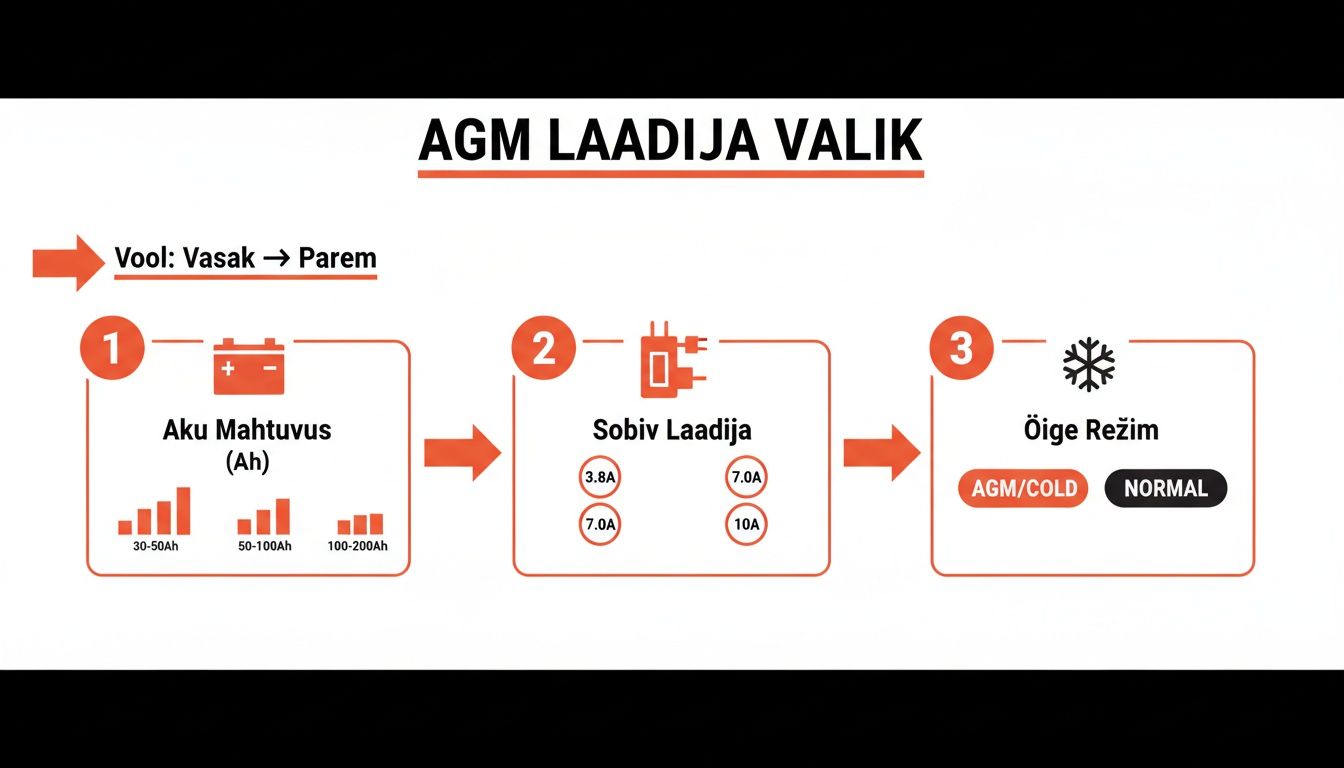
The image clearly shows how to find the right device based on the battery capacity and to definitely select a special AGM mode on it.
Should the battery be removed for charging?
This is one of the most common questions. Generally, it is not necessary. With a modern smart charger, charging an AGM battery directly under the hood is completely safe and convenient, especially if you do it regularly for maintenance or winter rejuvenation purposes.
However, there are some situations where removing the battery is definitely a better idea:
- Completely dead battery: If the battery is deeply discharged, it likely needs a special recovery mode. Removing the battery eliminates any risk that voltage fluctuations during charging could damage the car's sensitive electronics.
- Poor access: Some cars have the battery hidden in the trunk or under a seat, where ventilation is poor. In this case, it is definitely safer to remove the battery for charging.
- Cold weather: If you are charging the car in a cold garage where the temperature is near or below zero, it makes sense to bring the battery inside to warm up. A warm battery accepts current much better.
It is important to remember that disconnecting the battery in new cars can reset a whole range of settings – radio stations, clock, even window lifter memories. Sometimes it is even necessary to recalibrate systems at the dealership.
Once the charger is correctly connected and the AGM mode is selected, you can start charging. A good smart charger will do the rest: it will analyze the battery's condition, charge it as needed, and finally switch to maintenance mode. When the charger indicates that the process is complete, the battery is indeed 100% full and ready to serve you reliably again.
Common mistakes that can cost you when charging an AGM battery
Even if you have the newest and smartest battery charger in your garage, there are several ways to ruin an AGM battery. Unfortunately, many of these mistakes are still ingrained from the old "tin battery" era when technology was more forgiving. However, modern AGM battery charging is a fine science that requires precision and awareness.
The worst thing you can do to your AGM battery is to connect it to an old-fashioned transformer charger. These primitive devices mercilessly pump a constant current into the battery, without asking what condition the battery is actually in. Such a brutal approach is a sure death for an AGM battery, as it almost always ends in overcharging, gassing, and internal damage.
Using too high voltage and the temptation of fast charging
Another common deadly sin is using too high charging voltage. For some reason, there is a widespread myth that the more volts, the faster the battery can be charged. However, for AGM batteries, the voltage window is quite narrow, usually 14.4V to 14.8V. Exceeding this limit can cause the electrolyte in the glass mat to boil, drying out the battery from the inside and permanently destroying its capacity.
The same logic applies to fast charging. Of course, it is tempting to fully charge the battery in half an hour, but AGM technology values a slow and stable approach. Fast charging generates excessive heat in the battery, which is like an aging cure – chemical processes accelerate, and the battery plates wear out prematurely.
Here are some scenarios to avoid like the plague:
- "Shocking" a completely dead battery: Never try to "revive" a completely dead AGM battery from another car or with a powerful charger. You risk creating an internal short circuit.
- Choosing the wrong charging mode: If your smart charger has a separate AGM mode, use it. It’s there for a reason. The regular lead-acid mode will leave the battery undercharged, which is a direct path to sulfation.
- Charging in extreme conditions: A frozen battery should never be charged. Allow the battery to warm up to room temperature before connecting the wires.
An example from real life is the wrong "rescue" of a deeply discharged battery. If the battery voltage drops below 10.5V, many smart chargers simply do not recognize it. Some then try to "wake up" the battery with short current pulses, but this is a disservice for an AGM battery. The only right way is to use a charger with a special recovery mode.
Interrupted charging cycle and forgotten maintenance
One mistake that often doesn’t come to mind is leaving the charging cycle incomplete. A smart charger does not just fill the battery with current; it takes it through several stages. It is precisely these last phases – absorption and maintenance charging – that are critical for balancing the battery and achieving full capacity. If you remove the charger too early, you are actually leaving the job half done.
The importance of proper maintenance becomes especially clear when looking at the bigger picture. In Estonia, where the load on the transport sector is constantly increasing, reliability is paramount. For example, in the first quarter of 2025, there were 49.9 million trips made by public transport, the majority of which – 41.6 million – were accounted for by buses. Considering that harsh winter temperatures reduce battery power by 20-30%, flawless charging is the only way to keep vehicles on the road and avoid unexpected breakdowns. More detailed statistics can be found on the Statistics Estonia website.
Sometimes, something goes wrong during charging. The table below will help you quickly find the cause of the problem and a possible solution.
Troubleshooting table for AGM battery charging
| Problem | Possible Cause | Solution |
|---|---|---|
| The charger does not start charging | The battery is deeply discharged (voltage below 10.5V) and the charger does not detect it. | Use a charger with a special recovery mode or "force mode". If that doesn’t help, consult a specialist. |
| The battery gets hot during charging | The charging current is too high or there is an internal fault in the battery itself. | Immediately stop charging. Check the charger settings. If the problem persists, the battery is likely at the end of its life. |
| The charger never finishes charging | The battery is sulfated and can no longer hold a charge. | Let the battery sit after charging and measure the voltage. If the voltage drops quickly, it’s time to get a new battery. |
| The charging indicator keeps flashing | Poor connection at the terminals or incorrect polarity (positive and negative swapped). | Ensure that the charger clips are securely and correctly connected. Clean the terminals of corrosion and dirt. |
If you keep these common mistakes in mind and avoid them, you can be sure that your investment in a quality AGM battery will pay off with a long and trouble-free lifespan.
AGM battery maintenance and storage – a tip that significantly extends lifespan
Knowing how to properly charge your AGM battery is the foundation for a long battery life. However, to be honest, that’s only half the victory. Proper maintenance and thoughtful storage are just as important for your expensive battery to serve you for years, not just one season. This topic is especially sharp for seasonal vehicles that simply sit idle over the winter.

Regular maintenance is not rocket science. In fact, it is more a set of simple and logical actions that prevent problems and avoid premature wear. Always start with the simplest – just check the battery.
Clean terminals are the basis for good contact
Dirty and corroded battery terminals are one of the most common reasons why a car won’t start in the morning. This oxide layer on the terminals acts as an insulator, preventing current from flowing from the battery to the starter and, more importantly, from the charger to the battery. This means that even a fully charged battery may not start the car, and charging itself is extremely ineffective.
Cleaning the terminals is a simple but critical task:
- Get the right tools: You will need a wrench to loosen the terminals, a good wire brush, and a clean cloth.
- Safety first: Always disconnect the negative (–) black terminal first, and then the positive (+) red one. This prevents accidental short circuits.
- Clean thoroughly: Scrub off all corrosion and dirt with the wire brush. Clean both the battery terminal posts and the inner surfaces of the cable lugs.
- Protect against new corrosion: Once the terminals are cleaned and reconnected (this time in reverse order: first red, then black), coat them with a special terminal grease. This creates a protective layer that keeps moisture away and prevents new corrosion from forming. You can find a suitable product, such as special battery terminal grease, at any reputable auto parts store.
This small maintenance procedure takes only a few minutes but pays off greatly with reliable contact and trouble-free starting in any weather.
Storing seasonal vehicle batteries is a science in itself
Motorcycles, boats, campers, and convertibles often spend several months of the year in winter hibernation. If you simply leave the battery in the vehicle and forget about it until spring, you are likely to face an unpleasant surprise – a deeply discharged and damaged battery. AGM batteries do hold charge better than regular acid batteries, but self-discharge still inevitably occurs.
Deep discharge is the mortal enemy of an AGM battery. Every time the battery voltage drops below a critical level (around 12.4 V), the lead plates begin to sulfate. This is a chemical process that irreversibly reduces the battery's capacity and is comparable to rust.
The best solution to avoid this scenario is to remove the battery for the winter and store it in a dry, cool place, but definitely at a positive temperature. Ideal conditions are in the temperature range of 5–15 °C.
But it’s not enough just to put the battery on a shelf. It needs regular rejuvenation to prevent self-discharge from causing damage.
The importance of maintenance charging cannot be overstated
Maximizing the lifespan of a long-stored AGM battery hinges on maintenance charging. This means connecting the battery to a smart charger that keeps the voltage stable and compensates for any self-discharge.
There are two common approaches in practice:
- Periodic charging: Connect the smart charger to the battery every 1–2 months and let it complete a full charging cycle. This is a good option if you don’t want to leave the charger plugged in all the time.
- Continuous maintenance charging: Most modern smart chargers have a special maintenance mode (often referred to as float or maintenance). This means you can leave the charger connected to the battery throughout the storage period. The charger monitors the battery voltage and provides small current pulses as needed, keeping the battery constantly 100% charged without any risk of overcharging.
The second option is undoubtedly more convenient and a safer choice for the battery's health. It ensures that in spring, your battery is just like it was brought home from the store – fully charged and ready to go immediately. This small investment of time and electricity pays off greatly in the long run, saving you from the cost of buying a new battery.
AGM battery charging: frequently asked questions and answers
The world of AGM batteries may seem complicated and full of technical details at first glance. Over the years, we have heard all sorts of questions and seen many mistakes made with good intentions. Here we have compiled the most common questions and provided straightforward and practical answers – all to ensure your battery lasts long and works flawlessly.
Is an old "grandfather" charger suitable for AGM batteries?
This is a classic question, and the answer is short: no. Those old-school transformer chargers cannot regulate the voltage accurately enough for AGM technology. Charging with them almost always ends with the battery "boiling over" – too much gas and heat are generated, which permanently damages the internal structure of the battery. Always use a smart charger with a special AGM mode; it is the best investment in the battery's health.
How long does it usually take to charge an AGM battery?
Charging time always depends on three things: the size of the battery (Ah), the depth of discharge, and the power of the charger (A). A rule of thumb is that charging an average 100 Ah battery with a 10 A charger takes about 10–12 hours. Remember that slower and more stable charging is always healthier for an AGM battery. Don’t rush – rather allow a little more time.
What does the snowflake symbol on the charger actually mean?
The snowflake (❄️) indicates a mode designed for charging at low temperatures, usually below +5 °C. In cold weather, the chemical reactions in the battery slow down, and to compensate for this, the charger uses slightly higher voltage. Since this higher voltage is also ideal for AGM batteries, many manufacturers have started marking the AGM charging mode with the same symbol. Simple and logical.
How do I know when the battery is fully charged?
The safest bet is to trust your smart charger. Most modern devices have clear indicators – for example, a red light turns green, or a message "FULL" appears on the display. When the battery reaches 100% charge, the charger automatically switches to maintenance mode. This means you don’t have to worry about overcharging the battery, even if you forget to disconnect it.
Can I give current to an AGM battery using "crocodile clips"?
Yes, you can, but do it correctly and safely. The procedure is exactly the same as with a regular battery:
- Connect the red cable to the positive terminal (+) of both car batteries.
- Connect the black cable to the negative terminal (-) of the car providing the current.
- Connect the other end of the black cable to a bare metal part of the car with the dead battery – not directly to the negative terminal! This helps avoid sparks near the battery.
It is important to remember that jump-starting is an emergency solution. After starting the car, the discharged AGM battery needs to be properly fully charged with a smart charger as soon as possible. The car's generator alone can never fully restore a deeply discharged battery.
What happens if I charge an AGM battery with too powerful a charger?
If you use too high a current for charging – for example, trying to charge a 50 Ah battery with a 20 A charger – excessive heat will build up in the battery. This heat accelerates chemical processes, wears out the battery's internal components, and can literally "boil" the electrolyte. The result is a shorter lifespan and poorer capacity for the battery. Stick to the golden rule: the optimal charging current is about 10% of the battery's capacity in amp-hours (for example, a 70 Ah battery is suited for a 7 A charger).
Does the battery need to be removed for charging?
Generally, definitely not. With a modern smart charger, charging the battery under the hood is completely safe, provided there is sufficient airflow. The battery should only be removed in certain special cases:
- If the battery is deeply discharged and needs a special recovery mode.
- If the battery is located in a very hard-to-reach or cramped space.
- If you are charging the car in severe frost and want to bring the battery inside to warm it up for more effective charging.
Remember that disconnecting the battery in newer cars can reset the settings of electronic systems, which may later require a visit to the dealership. If you are unsure, it’s better to charge while it’s still in the car.
Proper care for the battery is as important as choosing the right oil for the engine. If you need suitable engine or transmission oil for your car, OILER offers a wide selection from top manufacturers. Check it out and find the best solution for your vehicle: https://oiler.ee.